Class XI Biology: Cell Cycle and Cell Division
This chapter explains the “Immortality of Life”—how a single cell becomes a trillion-celled human, and how life is passed from one generation to the next without losing the genetic blueprint.
The Rhythm of Life: Mastering Cell Cycle and Cell Division
Every living organism, whether a giant sequoia or a tiny amoeba, begins its life as a single cell. That cell must do two things to create a complex organism: grow and divide. This orchestrated sequence of events is called the Cell Cycle.
In this chapter, we explore Mitosis (the cloning process for growth) and Meiosis (the reduction process for reproduction). Understanding these stages is critical for understanding genetics, cancer, and evolution.
The Core Pillars of Cell Division
1. The Interphase: The Preparation
A cell spends about 95% of its time in Interphase. It’s not a “resting phase”; it’s a period of intense metabolic activity.
- G1 Phase: Cell growth and organelle duplication.
- S Phase (Synthesis): DNA replication happens here. The amount of DNA doubles (2C to 4C), but the chromosome number stays the same (2n).
- G2 Phase: Proteins are synthesized in preparation for mitosis.
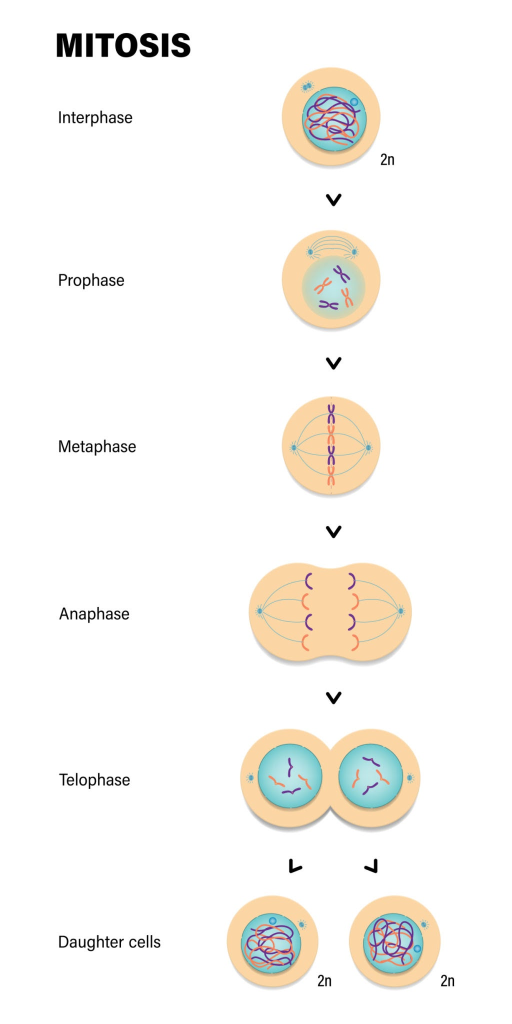
2. Mitosis: The Equational Division
Found in somatic cells, mitosis produces two daughter cells that are identical to the parent.
- Prophase: Chromosomes condense; nuclear envelope disappears.
- Metaphase: Chromosomes align at the equator (Metaphase plate).
- Anaphase: Sister chromatids pull apart.
- Telophase: Nuclear envelopes reform around the two new nuclei.
3. Meiosis: The Reduction Division
Meiosis occurs in germ cells to produce gametes. It reduces the chromosome number by half (2n to n).
- Meiosis I: The most complex phase. It features Prophase I, where genetic “Crossing Over” occurs, creating variation.
- Meiosis II: Essentially like mitosis, separating sister chromatids.
The Gauntlet: 10 Challenging Aptitude Questions
Question 1: The S-Phase Logic
If a cell has 24 chromosomes and a DNA content of 10 pg at the end of the G1 phase, what will be the number of chromosomes and DNA content at the end of the S-phase?
Question 2: The G0 “Quiescent” State
Some cells in the adult animal body do not appear to exhibit division (like heart cells). In which stage of the cell cycle are these cells “suspended”? Are they still metabolically active?
Question 3: The Metaphase Snapshot
Why is Metaphase considered the best stage to study the morphology (shape and size) of chromosomes under a microscope?
Question 4: Anaphase Arithmetic
During Mitosis, a cell with 46 chromosomes reaches Anaphase. How many “chromatids” (now called chromosomes) are moving toward the poles in total?
Question 5: Prophase I – The Five Sub-stages
Arrange the sub-stages of Prophase I in the correct chronological order: Diakinesis, Pachytene, Zygotene, Leptotene, Diplotene.
Question 6: The “Crossing Over” Event
In which specific sub-stage of Prophase I does the enzyme Recombinase facilitate the exchange of genetic material between non-sister chromatids?
Question 7: Mitosis vs. Meiosis II
Both Mitosis and Meiosis II involve the separation of sister chromatids. What is the fundamental difference between the “Parent Cell” that starts Mitosis vs. the one that starts Meiosis II?
Question 8: The Chiasmata Mystery
In which sub-stage of Prophase I do the homologous chromosomes begin to separate, but remain attached at the sites of crossing over (forming X-shaped structures)?
Question 9: Significance of Meiosis
If Meiosis did not involve a reduction in chromosome number, what would happen to the chromosome count of a species over 10 generations of sexual reproduction?
Question 10: Cytokinesis: Plant vs. Animal
How does the process of Cytokinesis (division of cytoplasm) differ between an animal cell and a plant cell? Hint: Think about the cell wall.
Detailed Explanations & Solutions
1. S-Phase Logic
DNA doubles, but chromosome number stays the same.
Result: 24 chromosomes and 20 pg of DNA.
2. The G0 Phase
Cells that do not divide further exit G1 and enter the G0 phase.
Result: They are metabolically active but do not proliferate unless called upon (e.g., during injury).
3. Metaphase Snapshot
Chromosomes are at their most condensed state and are clearly visible.
Result: They are neatly aligned at the equator, making them easy to count and measure.
4. Anaphase Arithmetic
In anaphase, each chromosome splits. If you started with 46, you now have 92 chromatids moving (46 toward each pole).
Result: 92 chromatids total.
5. Prophase I Order
Mnemonic: Little Zoo Pants Do Dance.
Result: Leptotene → Zygotene → Pachytene → Diplotene → Diakinesis.
6. Crossing Over
This happens during the “thick-thread” stage.
Result: Pachytene.
7. Mitosis vs. Meiosis II
Result: The cell starting Mitosis is Diploid (2n), while the cell starting Meiosis II is already Haploid (n).
8. Chiasmata
The dissolution of the synaptonemal complex begins here.
Result: Diplotene (X-shaped Chiasmata become visible).
9. Significance of Meiosis
The chromosome number would double every generation.
Result: It would lead to “polyploidy,” which is usually fatal in animals and would cause the species to lose its identity.
10. Cytokinesis Differences
Animal cells divide by Cleavage Furrow (outside-in). Plant cells have a rigid wall, so they form a Cell Plate (inside-out).
Result: Cell plate formation in plants; Furrowing in animals.
Pro-Tip: The “2n vs 2c” Secret
- n refers to the number of chromosomes (the physical units).
- c refers to the amount of DNA (the chemical content).Always remember: DNA doubles in S-phase, but chromosomes only double (temporarily) in Anaphase!