Class XI Biology: Animal Kingdom
This is one of the most content-heavy chapters in Biology, but the secret to mastering it is understanding the “Basis of Classification.” Once you know the levels of organization, everything else falls into place.
The Animal Multiverse: Mastering Animal Kingdom
From microscopic sponges to massive blue whales, the Animal Kingdom is incredibly diverse. However, every animal is a Multicellular Eukaryotic Heterotroph. To make sense of over a million species, biologists use a specific “Checklist” of physical features to group them into Phyla.
In this chapter, we explore the evolution of complexity—from animals that are just a loose collection of cells to those with complex organ systems and backbones.
The Core Pillars: Basis of Classification
1. Levels of Organization
- Cellular Level: Cells are loose aggregates (e.g., Porifera).
- Tissue Level: Cells performing the same function are arranged into tissues (e.g., Coelenterata).
- Organ/System Level: Tissues grouped into organs and systems (e.g., Aschelminthes to Chordates).
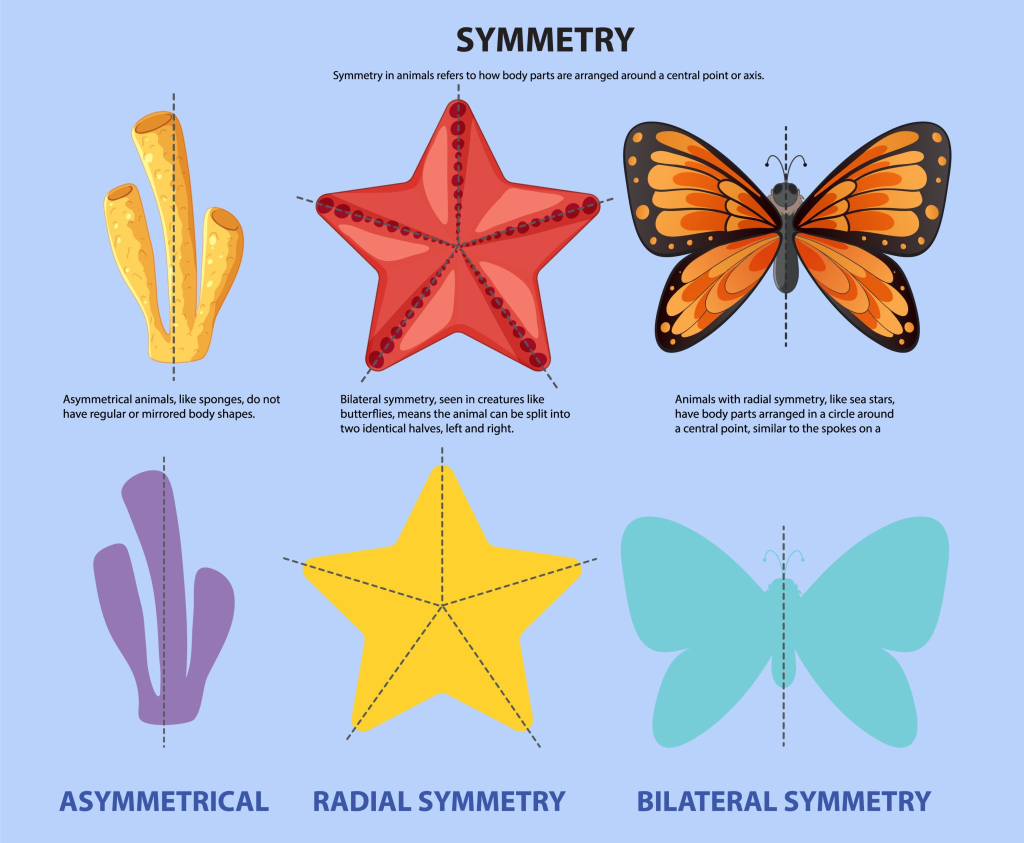
2. Symmetry
- Asymmetrical: Cannot be divided into equal halves (e.g., Sponges).
- Radial Symmetry: Any plane passing through the center divides the body into equal halves (e.g., Starfish, Ctenophores).
- Bilateral Symmetry: Can be divided into identical left and right halves in only one plane (e.g., Annelids, Arthropods).
3. The Coelom (Body Cavity)
This is the space between the body wall and the gut wall.
- Acoelomate: No cavity (Platyhelminthes).
- Pseudocoelomate: Cavity is present but not lined by mesoderm; instead, mesoderm is present as scattered pouches (Aschelminthes).
- Coelomate: True cavity lined by mesoderm (Annelida to Chordata).
The Phylum Gauntlet: 10 Challenging Aptitude Questions
Question 1: The Sponge’s Pump
In Phylum Porifera, water enters through minute pores and leaves through a large opening. Name these two structures and identify the specialized cells that line the canal system to maintain water flow.
Question 2: The Cnidarian Switch
Some Cnidarians (like Obelia) exhibit “Metagenesis.” What are the two body forms involved, and which one reproduces sexually vs. asexually?
Question 3: The “Comb” Power
Ctenophores are known for two distinct features: one related to locomotion and one related to light. Name them.
Question 4: The Flatworm’s Waste
Platyhelminthes are the first to develop specialized cells for excretion and osmoregulation. What are these cells called?
Question 5: The Pseudocoelom Exception
Identify the only Phylum in the animal kingdom that possesses a Pseudocoelom.
Question 6: The Arthropod Secret
Arthropoda is the largest phylum of Animalia. What is their exoskeleton made of, and how do they balance their bodies during movement (name the sensory organ)?
Question 7: The Molluscan Rasp
Most Molluscs have a file-like rasping organ in their mouth for feeding. What is it called?
Question 8: The Water Vascular System
In which Phylum is the “Water Vascular System” found, and what are its three primary functions? (Note: Do not confuse this with the canal system of sponges!)
Shutterstock
Question 9: The Chordate Four
What are the four fundamental characteristics that every Chordate must possess at some stage of its life?
Question 10: Cold vs. Warm Blood
Classify the following into Poikilothermous (Cold-blooded) and Homeothermous (Warm-blooded):
- Reptilia, Amphibia, Aves, Mammalia, Chondrichthyes.
Detailed Explanations & Solutions
1. Porifera Pump
Water enters through Ostia and exits through the Osculum.
Result: Choanocytes (or Collar Cells) line the canals and create the current.
2. Metagenesis
The two forms are Polyp (cylindrical/sessile) and Medusa (umbrella-shaped/free-swimming).
Result: Polyps produce Medusae asexually; Medusae produce Polyps sexually.
3. Ctenophore Features
They have eight external rows of ciliated Comb Plates for locomotion.
Result: Bioluminescence (the property of a living organism to emit light).
4. Flatworm Waste
Result: Flame Cells (Protonephridia).
5. Pseudocoelom Exception
Result: Aschelminthes (Roundworms).
6. Arthropod Secret
Their exoskeleton is made of Chitin.
Result: Statocysts are the balance-sensing organs.
7. Molluscan Rasp
Result: Radula.
8. Water Vascular System
Found in Echinodermata.
Result: Locomotion, Capture/Transport of food, and Respiration.
9. Chordate Characteristics
- Notochord. 2. Dorsal tubular nerve cord. 3. Paired pharyngeal gill slits. 4. Post-anal tail.Result: These four define the Phylum Chordata.
10. Body Temperature
- Poikilotherms: Chondrichthyes (Fishes), Amphibia, Reptilia.
- Homeotherms: Aves (Birds), Mammalia.Result: Birds and Mammals are the only ones capable of maintaining constant body temp.
Pro-Tip: The “Body Cavity” Shortcut
If you are asked about the coelom, remember this 3-step ladder:
- Platyhelminthes = Acoelomate (No space).
- Aschelminthes = Pseudocoelomate (False space).
- Annelida onwards = Coelomate (True space).